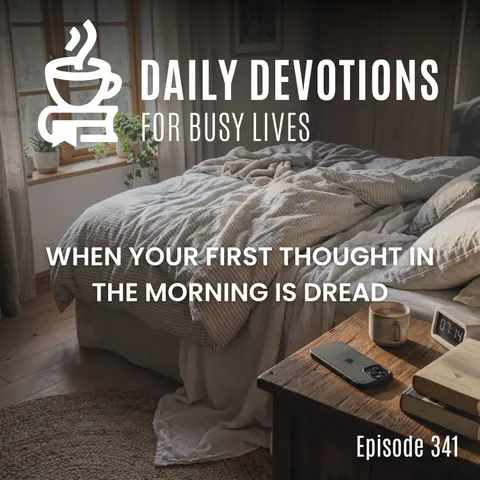
How to Stop the Morning Anxiety Spiral Before Your Feet Hit the Floor
Waking up with an immediate knot of dread in your stomach can derail your entire day before it even begins. By shifting your morning sequence and addressing the very first anxious thought at the top of the spiral, you can reclaim your morning routine and anchor your mind in God's unfailing love instead of panic.
Key Takeaways
- Morning anxiety often starts as a sequencing problem, where the very first thought triggers an unmanageable spiral of what-ifs.
- Within ninety seconds of waking up, checking a smartphone can flood your mind with outside fears and demands.
- The biblical character David experienced profound fear and distress, yet intentionally asked God to hear of His unfailing love each morning.
- Catching the very first thought at the top of the spiral allows you to question its truth before it pulls in multiple other worries.
- A simple one-week experiment of giving God the first ten minutes before touching your phone can fundamentally change your daily outlook.
The Anatomy of the Morning Anxiety Spiral
For many busy people, the alarm clock does not just signal the start of a new day; it sounds the alarm for a mental race that has already begun. You wake up, and before your feet even touch the floor, your brain is cataloging a massive list of responsibilities, upcoming deadlines, and unresolved conflicts from the previous day. This phenomenon is rarely just a passing mood. It is a rapid-fire mental cascade often referred to as an anxiety spiral.
When Bible teacher and author Jennie Allen examined her own struggles with overwhelming thoughts, she noticed a distinct pattern. The anxiety did not arrive all at once in a massive, unmanageable block. Instead, it nearly always began with a single, isolated thought. If left unchecked, that initial thought acted like a magnet, pulling in a second worry, then a third, until her entire mind felt completely underwater. By the time you attempt to process ten different crisis scenarios simultaneously at six o'clock in the morning, you have already lost the argument against your own imagination.
Why the Smartphone Accelerates the Panic
Compounding this internal vulnerability is our immediate physical habit upon waking. Most people reach for their smartphone within ninety seconds of opening their eyes. In doing so, you willingly hand over the microphone of your mind to external voices, news feeds, unread work emails, and social media notifications. Within moments, the digital world tells you precisely what you ought to be afraid of, what is failing, and what emergencies require your immediate attention before you have even taken a breath.
This is ultimately a sequencing problem. The anxious feeling or heavy knot in your chest may show up automatically, whether you approve of it or not. Biology and stress responses do not always wait for your permission. However, what you do retain absolute control over is what gets the first ten minutes of your consciousness.
Lessons from David: How to Pray When You Wake Up Afraid
It is easy to assume that biblical heroes lived lives untouched by modern panic, but the historical context of Scripture proves otherwise. When King David wrote Psalm 143:8, he was not sitting in a comfortable armchair sipping coffee. He wrote those words while hostile men were actively hunting him down, and in adjacent verses, he described his spirit as crushed and his heart as numb with fear.
Yet, in the middle of genuine terror, David made a deliberate choice regarding his morning routine. He prayed, "Let me hear of your unfailing love each morning, for I am trusting you. Show me where to walk, for I give myself to you."
Notice the intentionality of his request. David did not wait until he felt completely brave, peaceful, or secure before he talked to God. He approached God while he was still afraid. He wanted God's voice of unfailing love to be the very first voice that reached him each morning, cutting through the internal noise and the external threats.
Asking for the Next Few Steps
Notice also the second half of David's prayer: "Show me where to walk." This is not a demand for a comprehensive blueprint of the next five years, nor is it a request to solve every future crisis on the calendar. It is a localized, humble request for the next few steps—which is precisely as far ahead as any human being can see anyway.
When you wake up dreading the day, you are usually projecting your fears onto events that are hours away, such as a difficult meeting at four o'clock in the afternoon. But God does not hand out grace for four o'clock at six o'clock in the morning. He distributes that specific grace precisely when four o'clock arrives. Asking for strength for one hour—and only one hour—stops the mental weight from crushing you before the day has even started.
A Seven-Day Experiment to Reclaim Your Mornings
Breaking the cycle of morning dread requires practical leverage, and that leverage is found exclusively at the top of the spiral, when only a single thought has appeared. Instead of letting that first thought multiply, you can intercept it, evaluate its truth, and surrender it immediately.
Try this simple, transformative challenge for the next seven mornings:
- Leave the phone alone: Do not check your email, text messages, or news apps immediately upon waking. Guard the first ten minutes.
- Speak the truth out loud: Tell God the raw truth about what you are dreading today using whatever honest words come naturally to your mind.
- Pray David's anchor: Pray Psalm 143:8 back to God, asking to hear of His unfailing love first thing, and requesting strength and direction for just the next hour.
By giving God the first slot ahead of your schedule and your stressors, you train your mind to look upward before looking outward. To explore more short, encouraging devotionals designed specifically for demanding schedules, Listen to the full episode and discover how to stay grounded in God's Word no matter how full your life becomes.