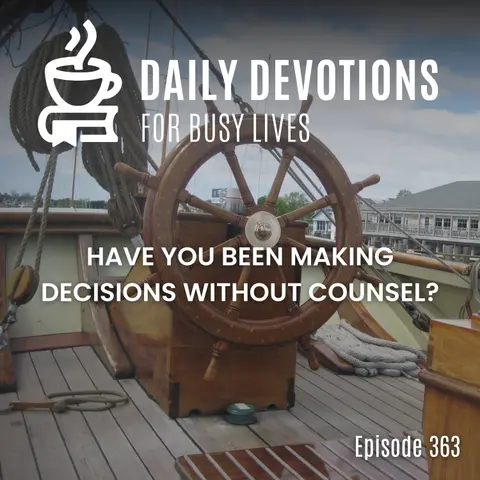
How to Ask Friends for Advice Without Looking for a Yes Man
When seeking guidance on major life choices, many Christians mistakenly surround themselves with supportive peers who merely validate preconceived plans. True biblical counsel functions as a steering mechanism rather than a cheering section, requiring intentional vulnerability, openness to constructive pushback, and a willingness to listen past the second sentence without immediate defense.
Key Takeaways
- Most people unintentionally seek out confirmation bias by asking friends who always agree.
- The Hebrew word for counsel implies a ship's steering rope, meaning true advice must be able to turn the wheel of your plans.
- One supportive friend is a sample of one, and you selectively chose that sample.
- Genuine spiritual counsel often acts as a rescue operation rather than just a helpful suggestion.
- Explicitly asking trusted believers what they would push back on gives them the necessary permission to be honest.
The Trap of the Cheering Section
It is a universal human tendency. You face a significant crossroads—a potential job change, a tense family dynamic, or a major financial commitment. You pray about it diligently, which is a vital first step, but then you rush to a decision. To feel more secure in your conclusion, you run the idea past a trusted friend or sibling. When they smile, nod, and tell you to go for it, a wave of relief washes over you. You feel supported, anchored, and ready to move forward.
Yet, if you examine that interaction closely, you have to ask yourself a hard question: Were you actually seeking objective advice, or were you simply hunting for a green light? We often consult people precisely because we already know how they will respond. We curate our inner circle to include individuals who mirror our values, our preferences, and our secret desires. When they validate our inclinations, we mistake consensus for divine confirmation.
Why Yes Men Fail Us in High-Stakes Decisions
When you take a personal dilemma to someone who loves you deeply but lacks the fortitude to challenge you, you create an echo chamber. A friend who instinctively tells you yes whenever you present an idea is a sample size of one—and you handpicked that sample. They care about your immediate comfort, your happiness, and maintaining a smooth relational dynamic. They do not want to see you squirm or feel stressed.
Unfortunately, high-stakes life decisions do not care about your comfort. As Solomon observed in the biblical proverbs, ignoring wise counsel can lead to catastrophic failures, much like King Rehoboam who ignored veteran elders in favor of young peers who told him what he wanted to hear, ultimately fracturing a kingdom. If your advisors never challenge your blind spots, they are passengers in the car, not drivers helping you navigate hairpin turns.
The Hebrew Picture of Steering and Rescue
To truly understand what biblical writers meant by counsel, we have to look past modern therapeutic definitions and examine the ancient Hebrew vocabulary. The word most often translated as counsel is tachbulot. Scholars trace this term back to chevel, which refers to the heavy rope connected to a ship's rudder.
Picture a massive sailing vessel caught in a violent storm at sea. Without lines connected to the rudder, the ship is entirely at the mercy of the wind and waves, inevitably crashing against the rocks. The steering mechanism is the only thing keeping the boat afloat. In the same way, true spiritual counsel is not a casual tip; it is a steering mechanism. A voice that merely agrees with everything you say never touches the wheel. True steering requires someone who is physically willing to grab the rudder and pull hard in a direction that might feel uncomfortable in the moment.
Furthermore, the biblical term associated with the safety found in multiple counselors is teshu'ah, which roots itself in words meaning rescue, salvation, and victory. Solomon viewed getting advice not as a mild administrative preference, but as a critical rescue operation. Surrounding yourself with people who will disagree with you when necessary can save you from self-inflicted disasters.
How to Solicit Real Pushback This Week
Breaking the habit of seeking out yes-men requires deliberate, counter-intuitive action. Most mature believers will naturally default to kindness and encouragement unless you explicitly hand them permission to do otherwise. If you want genuine counsel, you have to change how you frame the conversation.
The Two-Person Challenge
First, identify a decision you have been turning over in your mind for weeks. Next, select two mature believers who know you intimately, understand your tendencies, and have a proven track record of speaking hard truths without malice. These should be people who have never been afraid to tell you something you preferred not to hear.
When you sit down with them this week, lay out your plan honestly. Tell them what you are leaning toward. But then, instead of asking for their blessing, ask them this specific question: "What would you push back on if you were in my shoes?"
Give them explicit permission to poke holes in your logic. And then comes the hardest part: listen. Around sentence two of their critique, your defensive reflexes will kick in. You will feel an overwhelming urge to interrupt, clarify, or explain away their concerns. Resist that urge. Let them finish completely. Their willingness to challenge you might just be the rescue operation God is using to guide your next big step.
Conclusion
Navigating life's major transitions requires more than just personal prayer and a supportive sounding board; it requires a community of faith willing to steer you away from danger. If you are ready to stop looking for simple validation and start embracing true biblical wisdom, Listen to the full episode of Daily Devotions for Busy Lives. Join Dr. Bart Leger as he unpacks practical ways to anchor your daily decisions in God's Word without getting overwhelmed by your busy schedule.