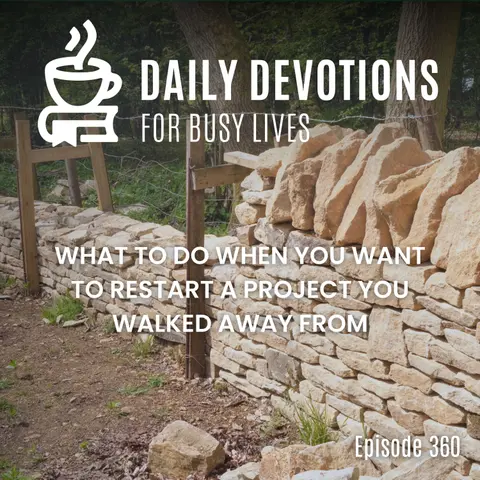
How to Overcome the Fear of Restarting an Abandoned Ministry or Goal
Overcoming the fear of restarting an abandoned ministry or personal goal requires confronting the psychological weight of past failure, silencing the fear of public judgment, and breaking a massive, overwhelming vision down into the smallest possible micro-steps right in front of you.
Key Takeaways
- Admitting a project failed the first time is the primary psychological barrier to restarting.
- Fear of what others will think keeps many potential creators and leaders paralyzed.
- Nehemiah's silent inspection method teaches us to assess damage objectively before making announcements.
- Focusing on the immediate, micro-step in front of you prevents overwhelm.
- Collaboration and asking for help are essential when taking on a daunting second attempt.
The Hidden Cost of Coming Back
Most people do not abandon important projects, ministries, or creative pursuits because they run out of talent. They abandon them because life happens—burnout, financial pressure, unexpected illnesses, or a season of heavy family responsibilities. Walking away often feels like the wisest, most responsible choice at the time. Yet, months or years later, a lingering sense of unfinished business remains.
When you contemplate going back, you immediately hit a wall of invisible resistance. The hardest part of a restart is rarely the mechanical labor itself; it is the emotional and psychological toll. You have to look yourself in the mirror and admit that your first attempt did not cross the finish line. Worse still, you have to face the people who watched you walk away.
This dynamic creates a severe mental paralysis. Will people think you are flaky? Will they roll their eyes at your renewed enthusiasm? And perhaps the deepest, quietest fear of all: What if you try again, invest your heart, and fail a second time? Overcoming these barriers requires more than sheer willpower; it requires a strategic, proven framework for picking up what you laid down.
The Nehemiah Blueprint for Assessing Ruins
History and Scripture offer profound insight into how to approach a ruined project without letting anxiety take the steering wheel. When Nehemiah heard about the broken walls of Jerusalem, he was looking at a project that an entire city had already attempted, abandoned, and given up on. The ruins were a monument to a failed effort.
Notice what Nehemiah did when he finally arrived in the city. He did not immediately call a press conference, rally the troops, or launch a public relations campaign. Instead, he practiced strategic silence. He stayed quiet for three days.
After those three days, he got up in the middle of the night, took a small group of trusted men, and rode the length of the wall in total secrecy. He inspected every burned gate and every pile of rubble. He looked the reality squarely in the face without sugarcoating the damage.
Why Inspection Comes Before Announcement
Many would-be restorers make the mistake of announcing a grand comeback before they have truly measured what is broken. They run on raw emotion, only to burn out within a week when they realize the scope of the problem. Nehemiah teaches us that a sober, quiet assessment must always precede a public announcement. You must know the exact state of your own broken walls—whether that is a neglected manuscript, a shelved non-profit idea, or a pastoral calling you thought you had outgrown—before you can invite anyone else to help you build.
Micro-Steps and the Power of the Local Section
Once you have inspected the ruins, the natural tendency is to panic at the sheer volume of work required. How do you write a whole book after not touching a word for three years? How do you step back into leadership after a painful exit?
The answer is found in the architectural genius of Nehemiah chapter 3. When the rebuilding finally began, it was divided among roughly forty crews. But the text repeats a remarkably grounding detail over and over again: every group worked on the section of the wall directly opposite their own house. Nobody was handed the entire perimeter. Every single person simply took ownership of the stretch of wall immediately in front of where they already lived.
This principle is revolutionary for personal productivity and spiritual renewal:
De-escalate the scope: Stop trying to fix the whole project at once. Reduce the vision to a micro-step.
Look at your current radius: What is the spiritual, professional, or creative equivalent of your own front doorstep this week?
Commit to a temporary trial: Much like taking a three-month adjunct role rather than committing to a permanent career pivot, give yourself permission to test the waters with a low-stakes, time-bound engagement.
Conclusion
Restarting an abandoned project does not require an immediate, flawless, heroic charge. It requires the humility to survey what went wrong, the courage to quiet the critics in your head, and the discipline to lay just one brick right where you are standing today. If you have been wrestling with a shelved dream, take heart in the fact that God is not finished with the things you laid down.
To dive deeper into this topic and hear a powerful modern story about stepping back into a calling after years away, be sure to Listen to the full episode of Daily Devotions for Busy Lives. Take five minutes today to write down your abandoned project, identify the smallest possible action step you can take before the week is out, and start building your section of the wall.
Frequently Asked Questions
How do I know if I actually quit too soon or if walking away was the right choice?
Walking away is often the right choice during seasons of burnout, health crises, or major life transitions. You can know it is time to restart when the underlying passion or calling returns, accompanied by a renewed sense of capacity and peace about trying again.
What should I do if people remember my first attempt failing?
Focus on quiet obedience rather than public spectacle. You do not need to issue a grand manifesto or apologize for past stops and starts. Simply take a small, tangible action step in your immediate sphere of influence and let consistent progress speak for itself.
How can I avoid getting overwhelmed by the sheer amount of work a restarted project requires?
Adopt the 'section opposite your house' strategy from Nehemiah. Break the overarching project down into micro-tasks—such as making a single phone call, writing one page, or committing to a three-month trial period—rather than trying to finish everything at once.
Is it wise to ask for help when restarting an old goal?
Absolutely. Nehemiah did not rebuild the wall alone, nor did he intend to. Involving trusted friends, mentors, or collaborators provides accountability, lightens the load, and dramatically increases your chances of seeing the project through to completion.